· 6 min read
The English Freemasons of Bahía Blanca and the foundation stone of the Anglican church
In a wall of St Paul’s Anglican Church, in Gorriti Street, there is a stone inscribed in English that few people stop to read. It was laid in 1911 by English Freemasonry. What it says, who laid it, and what became of Albion and White Bay, the two lodges of the British in Bahía Blanca.
This is an English translation of an article first published in Spanish on 18 October 2026: ‘Los masones ingleses de Bahía Blanca y la piedra de la iglesia anglicana’.
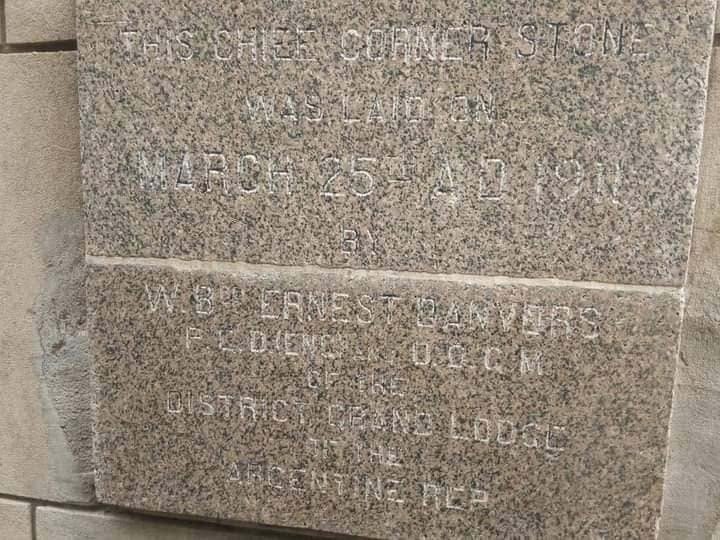
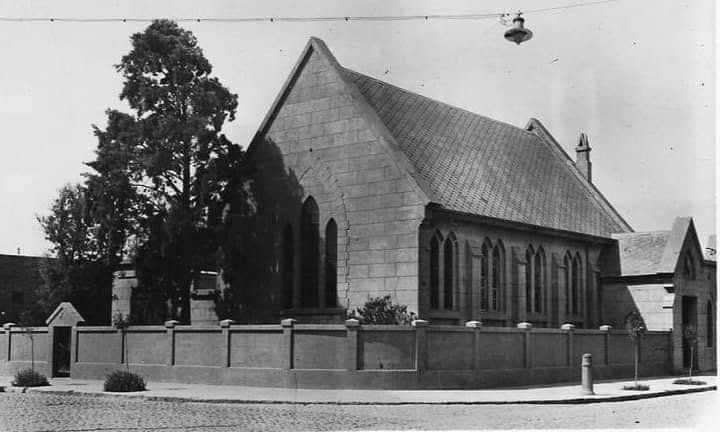
At Gorriti 818, a few metres from Almafuerte Street, stands St Paul’s Anglican Church. In one of its walls there is a granite stone with an inscription in English, all in capital letters. Many people in Bahía Blanca walk past without reading it, and those who do can hardly make sense of its abbreviations. What it says is that the stone was laid by the Freemasons.
What the stone says
The inscription runs to ten lines: This chief corner stone was laid on March 25th A.D. 1911 by W. Bro. Ernest Danvers, P.G.D. (Eng.), D.D.G.M. of the District Grand Lodge of the Argentine Rep.
Spelt out: this chief corner stone was laid on 25 March 1911 by Worshipful Brother Ernest Danvers, Past Grand Deacon of the Grand Lodge of England and Deputy District Grand Master of the District Grand Lodge of the Argentine Republic.
The English lodges working in Argentina did not belong to Argentine Freemasonry but to the United Grand Lodge of England, which grouped them into a District under its own District Grand Master. Danvers was the second in command of that District. In 1902 an English Masonic magazine described it as the most extensive of all the Districts under the English Constitution.
An English custom
For the English of the time, there was nothing unusual about a Freemason laying the foundation stone of a church. In nineteenth-century and early twentieth-century England, many churches and cathedrals had their stones laid ‘with Masonic honours’, in public ceremonies in which the best-known Freemasons of each place took part.
The British of Bahía Blanca brought that tradition with them. Many had arrived with the Ferrocarril Sud, the British-owned Buenos Aires Great Southern Railway, which reached the city in 1884. The marble fountain that the community gave for the centenary of 1928, in Plaza Rivadavia, recalls this: according to the Municipality, two of the four engines of progress it represents, the railway and navigation, had been brought by the English. And each figure faces its own place: the locomotive looks towards the station; the ship, towards the port.
The lodges of the English
By then the community already had two lodges of its own. Albion Lodge, No. 3196, had been founded in 1907; White Bay Lodge, No. 3319, a year later. We introduced them in our article on the fourteen lodges (in Spanish), and in the story of the Freemasons who spoke Italian (article in Spanish) we explained that they were a world apart, reserved for British subjects.
The historian Rodrigo Vecchi recorded a detail that ties the pieces together: Albion was linked to the local Anglican Church. The stone names neither lodge, but a letter from those days tells us who organised the ceremony and what the building was for.
The invitation
The letter is dated Bahía Blanca, 22 March 1911, three days before the ceremony. It is typewritten in Spanish, with the dotted abbreviations that Freemasons use, and it is addressed to the Worshipful Master of Giordano Bruno Lodge, a lodge of Argentine Freemasonry founded in the city in 1909, with a mostly Italian membership.
On behalf of Albion, it invites the Worshipful Master and the brethren of Giordano Bruno to the laying of the foundation stone of the ‘building intended as an Anglican Chapel and Masonic Temple’ (in the original Spanish, ‘Edificio destinado a Capilla Anglicana, y Templo Masónico’). It asks them to come wearing their regalia and the jewels of their degree, and asks them to assemble at 3.30 p.m. at a marquee put up as a meeting point at the corner of Rondeau and Atacama. Atacama is today’s Almafuerte Street.
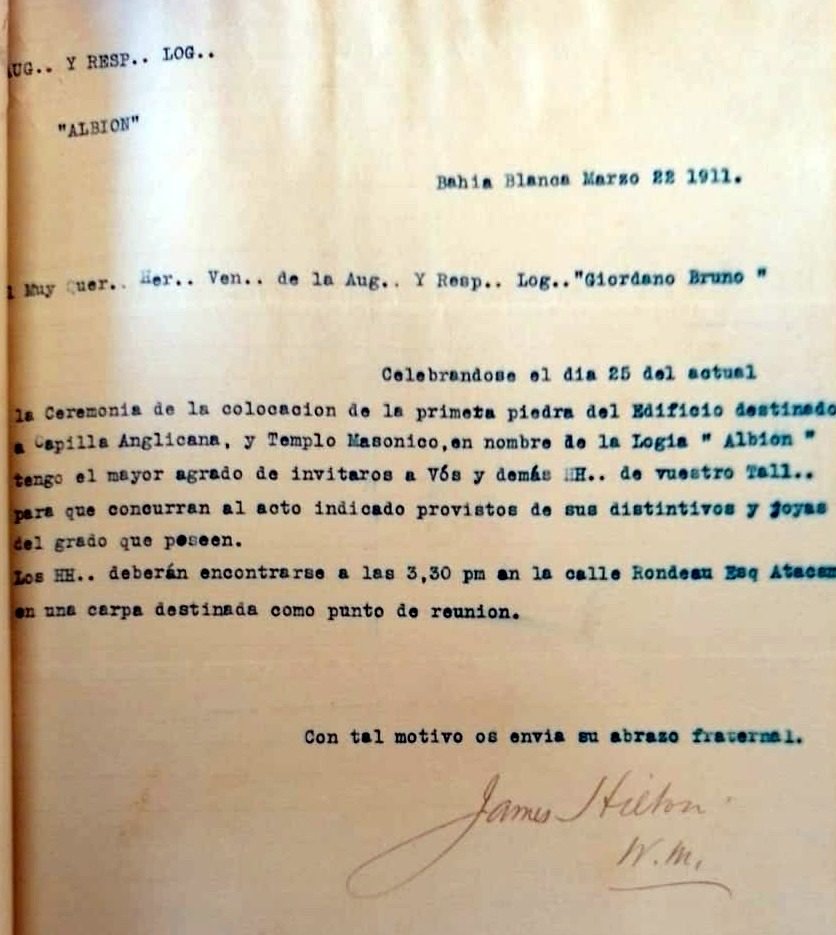
It is signed by James Hilton, and below the signature are two letters: W.M., Worshipful Master, the English title that corresponds to the Venerable Maestro of Argentine lodges. According to the historian José Eduardo de Cara, Hilton was one of the founders of Albion, and the lodge’s first home was in fact at the corner of Atacama and Gorriti.
The letter fills in what the stone left unsaid. The ceremony was organised by Albion, and the building was not conceived only as a church: it was also to be a Masonic temple. The work went quickly: according to La Nueva, the building was opened in August of that same year.
And it shows something more. The English lodges worked apart, reserved for British subjects, but they invited the lodges of Argentine Freemasonry to their ceremonies. Twelve years later, White Bay would do the same with the Liverpool lodge of Ingeniero White.
Two jewels
Few objects remain from those lodges. Two of them are jewels, as Freemasons call the medals that identify a lodge or an office.
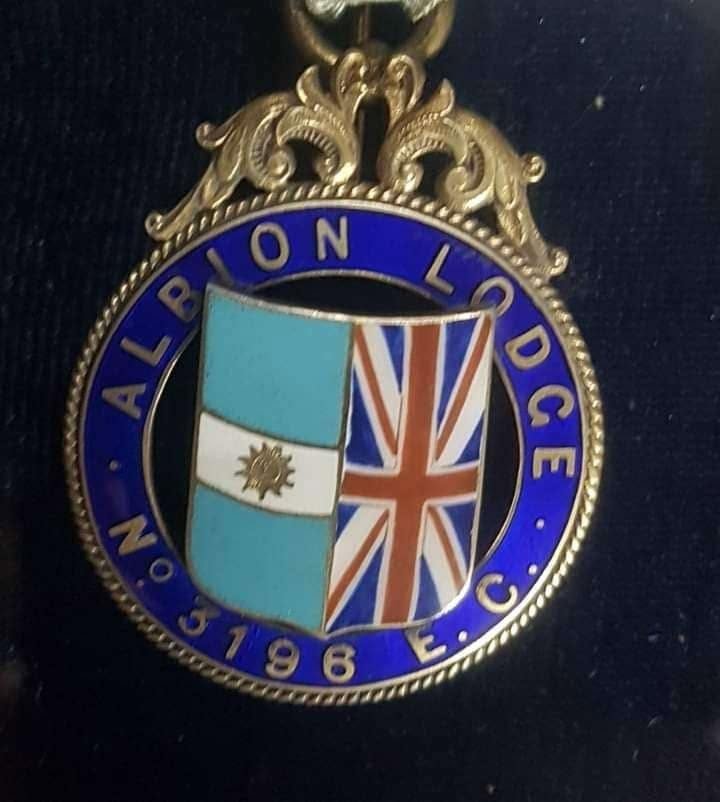
Albion’s is a circle of blue enamel bearing the lodge’s name, its number and two letters, E.C., for ‘English Constitution’. In the centre, a shield divided in two: on one side the Argentine flag, on the other the British. For a lodge of British subjects, the message is clear: English, but in Argentina.
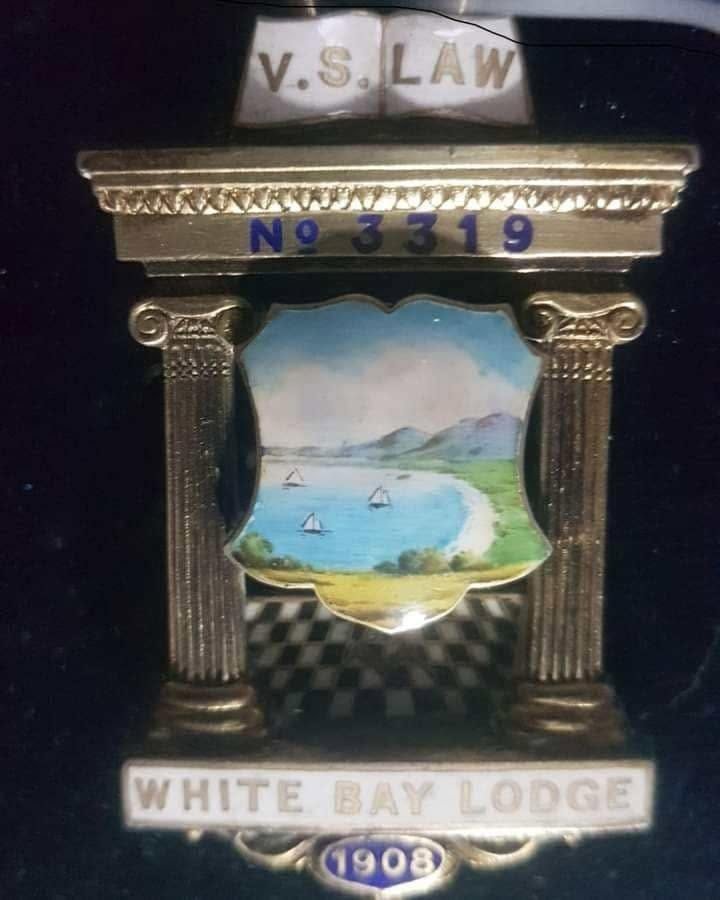
White Bay’s, dated 1908, is a small piece of goldsmith’s work. At the top, an open book with the letters V.S. Law: the Volume of the Sacred Law, as English Freemasons call the holy book that lies open at every meeting. Below it, two pillars on a chequered pavement. And in the centre, painted in enamel, a bay with sailing boats. The name needs no explanation: White Bay is Bahía Blanca in English.
Thirty-three days
The stone in Gorriti Street was laid on 25 March 1911. Thirty-three days later, on 27 April, our lodge was founded: Bartolomé Mitre No. 264. In that same southern autumn, two different Freemasonries, one English and one Argentine with a mostly Italian membership, were leaving their mark on the city. More than a century later, ours is still at work, now in the temple in Saavedra Street (article in Spanish).
What became of them
Albion was one of the longest-lived: it was still working after 1933, when almost all the lodges the city had known had ceased to meet. In 1963, according to De Cara, it moved to Hurlingham, in Greater Buenos Aires, where it again met in an Anglican church until the early 1970s. Of White Bay, the last document we know of dates from 1923. Today no English lodge works in Bahía Blanca. The stone, however, is still in its place.
Does your family keep a jewel, a certificate or a photograph from Albion or White Bay? Or the newspaper from late March 1911 with the report of the ceremony? We would love to see it. You can write to us through our contact form: it is in Spanish, but you are welcome to write in English.
Sources. Inscription on the foundation stone of St Paul’s Anglican Church, Gorriti 818. Letter from Albion Lodge to the Worshipful Master of Giordano Bruno Lodge, Bahía Blanca, 22 March 1911. Rodrigo J. Vecchi, ‘Rumbo al Oriente Eterno’. Ismael Haouache, ‘Masonería e inmigración italiana en Bahía Blanca’, in Mariana Annecchini (ed.), Múltiples contextos y abordajes en el estudio de la masonería, 2025. José Eduardo de Cara, Medallas de logias masónicas inglesas en el Río de la Plata, cited by Enrique Octavio Mujica in ‘La logia masónica en el barrio inglés’, Hurlingham al Día, 16 August 2025. On the church: ‘Iglesia Anglicana’, La Nueva, 9 August 2011. The Masonic Illustrated, 1 November 1902. On stones laid with Masonic honours: ‘Seven Masonic foundation stones for churches and cathedrals in England’, website of the historian David Harrison. On the fountain and the railway: Municipality of Bahía Blanca (in Spanish).
R∴L∴ Bartolomé Mitre N° 264
El contenido de este artículo expresa la opinión del o los autores y no representa el pensamiento o posición de la Masonería como institución.
The content of this article expresses the opinion of its author or authors and does not represent the thinking or position of Freemasonry as an institution.